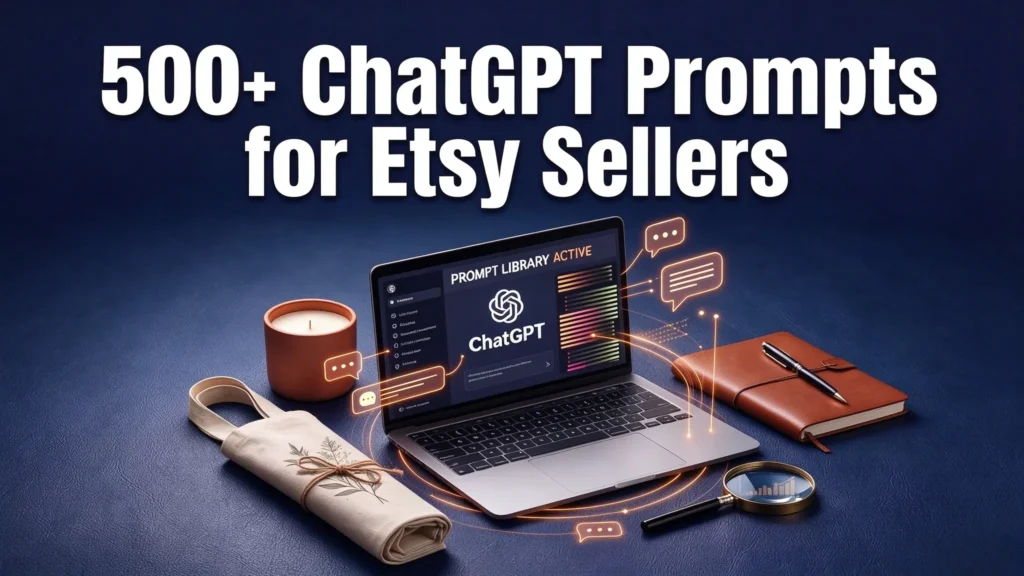
A complete AI prompt library for Etsy sellers covering product research, Etsy SEO, listing optimisation, customer service, social media, promotions, digital products, print-on-demand, handmade shops, and everyday Etsy business tasks.
Running an Etsy Shop Is More Than Making Products
Running an Etsy shop can look simple from the outside.
Create a product. Upload it. Write a description. Wait for orders.
Anyone who actually runs a shop knows there is much more happening behind the scenes.
You need product ideas. You need to research what buyers may want. You need titles, descriptions, tags and images. You need customer replies. You need social content. You need promotional ideas. You need to keep your shop organised while still finding time to create the products themselves.
That is where ChatGPT can become useful.
But there is a catch.
Opening ChatGPT and typing “write my Etsy listing” does not magically produce a great listing.
The better question is:
What should you actually ask ChatGPT to do?
That is the problem a structured prompt library can solve.
ChatGPT for Etsy Sellers Is Most Useful When the Task Is Specific
AI works best when you give it a clear job.
Instead of asking for “Etsy marketing ideas”, you might ask it to develop promotional angles for a particular product, buyer and season.
Instead of “write an Etsy description”, you can provide the product details, target customer, positioning and tone and ask for a specific structure.
Instead of “help with SEO”, you can work through keyword ideas, titles, tags, descriptions and related search terms one stage at a time.
This changes ChatGPT from a general chatbot into a practical working assistant.
The 500+ ChatGPT Prompts for Etsy Sellers library is built around that idea. Rather than presenting one enormous random collection of prompts, it organises them around shop types, goals, listing assets, marketing channels and experience levels.
That organisation matters when you are working quickly.
You do not want to spend ten minutes searching for the right prompt before you have even started your actual task.
Start With Product Research
A weak product idea can create problems much later.
You may spend hours designing something only to discover that the audience is unclear, the positioning is weak or the listing is difficult to differentiate.
ChatGPT can help you explore product concepts before you commit too much time.
You can use AI to brainstorm variations around a niche, identify different buyer motivations, develop gift-oriented angles, compare product concepts and organise research questions.
It does not mean every AI-generated idea is good.
In fact, many will not be.
The useful part is the speed at which you can generate possibilities and then apply your own judgement.
For Etsy sellers, this can be particularly helpful when developing product collections rather than isolated listings.
A single strong product concept can lead to related colours, themes, occasions, audiences, formats or complementary products.
AI can help you explore that territory much faster.
[GET 500+ CHATGPT PROMPTS FOR ETSY SELLERS ON AMAZON]
Etsy SEO Is More Than Putting Keywords Everywhere
Etsy SEO can become confusing because sellers often think the goal is simply to add as many keywords as possible.
That is not a useful way to approach it.
You need to think about what a buyer might actually search for.
A buyer looking for a handmade wedding gift may search differently from someone looking for a printable planner.
A customer shopping for a print-on-demand shirt may use different language from someone buying vintage goods.
That means your search language should reflect the product, audience and buying situation.
A structured ChatGPT workflow can help you generate and organise potential search terms, then use them when developing titles, tags and descriptions.
The key word is potential.
AI suggestions still need to be checked.
If a keyword does not accurately describe the product, do not use it simply because it sounds popular.
Relevance comes first.
Product Descriptions Need to Sound Like the Product
A generic description is easy to spot.
“This beautiful product is perfect for everyone and makes a wonderful gift.”
That sentence could describe almost anything.
A better Etsy product description gives the buyer useful information while making the product feel relevant to a particular person.
What is it?
Who is it for?
Why might they want it?
What makes it different?
When would they use it?
What should they know before purchasing?
ChatGPT can help you create several versions and test different structures.
You can also give it your preferred brand voice so your listings do not all sound like they were written by the same generic marketing template.
The prompt system behind this book is designed around variables that can be changed for the specific shop, product, goal and context.
That makes the prompts reusable rather than tied to one product.
Customer Service Is Another Underrated Use for AI
Selling products means answering questions.
Some are easy.
Some arrive for the tenth time.
Some require a careful response because the customer is unhappy.
You can use ChatGPT to create response frameworks for common situations such as product questions, delivery concerns, personalisation requests, returns, revisions and follow-ups.
The important rule is simple:
Never let AI invent information about your shop.
Give it your actual policies.
Give it your actual delivery information.
Give it the facts about your product.
Then ask it to turn those facts into a clear, friendly response.
That can reduce repetitive writing without giving the AI authority to make promises on your behalf.
A good prompt can help you respond faster while still keeping the final decision and communication under your control.
Your Social Media Content Can Start From Your Etsy Products
An Etsy seller can easily fall into this cycle:
Create product.
Upload product.
Forget to promote product.
Create another product.
Repeat.
Social media gives you another way to bring attention to your shop, but creating fresh content for Pinterest, Instagram and TikTok can become a job in itself.
AI can help turn one product into multiple content angles.
For example, the same product could become:
A problem-focused post.
A seasonal idea.
A gift suggestion.
A behind-the-scenes post.
A product-use example.
A frequently asked question.
A comparison.
A short video concept.
The goal is not to publish every idea.
The goal is to create a larger pool of usable ideas so you can choose the strongest ones.
The prompt library includes dedicated social media workflows covering platforms such as Pinterest, Instagram and TikTok.
Different Etsy Shops Need Different Prompts
This is one of the reasons a huge generic prompt collection can be less useful than a well-organised one.
A handmade jewellery seller does not have exactly the same problems as a digital planner seller.
A print-on-demand shop does not operate like a vintage shop.
The product itself changes the marketing language, buyer expectations and content requirements.
The guide therefore includes shop-type packs covering handmade, print-on-demand, digital products, vintage and craft supplies, alongside goal-based packs for launches, seasonal activity, fixing problems, social growth and average order value.
That gives sellers a way to start with their actual business model instead of trying to adapt every prompt from scratch.
What About ChatGPT and Etsy Product Ideas?
This is where I would be careful.
AI is excellent for brainstorming.
It is not a replacement for market validation.
If ChatGPT gives you 50 product ideas, that does not mean you have 50 products with proven demand.
You still need to investigate the market.
Look at existing products.
Study competing listings.
Read reviews.
Look for gaps.
Consider production cost and time.
Think about whether the product fits your capabilities.
Then make the decision yourself.
AI can make the research process faster.
It cannot remove the need for judgement.
You Can Also Use AI to Improve Existing Listings
You do not always need another product.
Sometimes your existing catalogue is the better place to start.
Pick five listings.
Ask ChatGPT to review the titles, descriptions, buyer clarity, keyword relevance, benefits and calls to action.
Then compare its recommendations with your own knowledge of the product.
You may discover that the listing is too generic.
Perhaps the important benefit is buried halfway down the description.
Maybe the language is aimed at the wrong buyer.
Maybe the title is trying to say too much.
Maybe your product photographs communicate something different from the written listing.
This type of audit can turn AI into an improvement tool rather than just a content-generation tool.
Build a Prompt Library for Your Own Shop
One of the most useful habits you can develop is saving prompts that work.
Suppose you discover a prompt that consistently helps you create better product descriptions.
Save it.
Then create variables for:
[PRODUCT]
[TARGET BUYER]
[KEY FEATURES]
[STYLE]
[OCCASION]
[PRICE POSITIONING]
[BRAND VOICE]
Now you have a reusable template.
Do the same for customer replies.
Then SEO research.
Then social posts.
Then seasonal campaigns.
Eventually, you have your own Etsy AI operating system.
That is much more valuable than a collection of prompts you use once and forget.
More Prompts Does Not Automatically Mean Better Results
This is worth saying because “500+” sounds impressive.
The number itself is not the main benefit.
The value comes from having prompts organised around real jobs.
The guide contains 500+ prompts across 14 parts, including product research, SEO titles and tags, product descriptions, customer service, branding, social media, promotions, bundles and upsells, troubleshooting, shop-type packs, goal-based packs, prompt variations, prompt upgrades and niche-specific prompts.
That makes it possible to treat the book as a working reference rather than something you read from beginning to end.
Open it when you have a problem.
Find the relevant section.
Replace the variables.
Run the prompt.
Review the output.
Adapt it to your shop.
Move on.
The Best Way to Start
Do not try 50 prompts tonight.
Choose one area where you are currently losing time.
If your listings are weak, start with listing prompts.
If you struggle with Etsy SEO, start there.
If you keep postponing social media, build a small content workflow.
If customer messages are taking too much time, create response templates.
If you are not sure what to sell next, begin with product research.
Then test the process.
Keep what helps.
Change what does not.
And never publish AI output simply because the AI produced it.
Your shop still needs your judgement, your product knowledge and your understanding of your customers.
AI should make those strengths easier to apply, not replace them.
Want a Practical Etsy AI Prompt Library?
If you want a single reference you can return to whenever you are working on your Etsy shop, 500+ ChatGPT Prompts for Etsy Sellers brings the workflows together in one place.
You get prompts for SEO, listings, customer service, branding, social media, promotions, shop growth and more, with sections tailored to different Etsy business models.
[EXPLORE 500+ CHATGPT PROMPTS FOR ETSY SELLERS ON AMAZON]
And if you are interested in practical ways to use AI beyond Etsy, you can also get the free ebook:
AI Superpower for Everyone
It is designed for people who want to discover practical AI applications across work, business, creativity and everyday tasks.
[DOWNLOAD AI SUPERPOWER FOR EVERYONE]

You do not need to become an AI expert.
You need to know what you are trying to accomplish, give the AI enough context, review what it gives you and build reusable workflows around the tasks you repeat.
For Etsy sellers, that can start with one good prompt.
Then another.
Then another.
Eventually, those prompts can become a system.
Get 500+ ChatGPT prompts for Etsy sellers and start building yours today.